Preprint · 2026
TL;DR Whole-hand force regulation without tactile sensing: contacts on every hand link are estimated from the tracked object model and joint angles, and the contact forces are re-solved every control cycle as the contacts change.
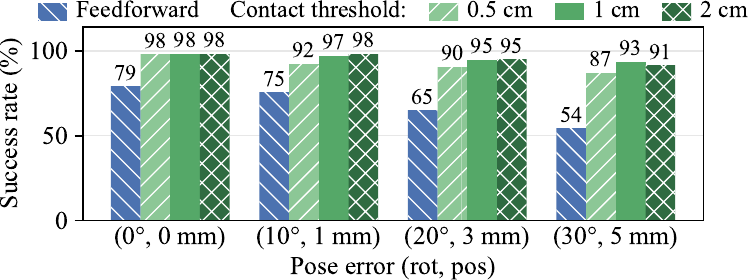
About 3,000 points on the hand links are queried against the object's signed distance field each cycle. Points within 1 cm are contacts. Under 1 ms on GPU.
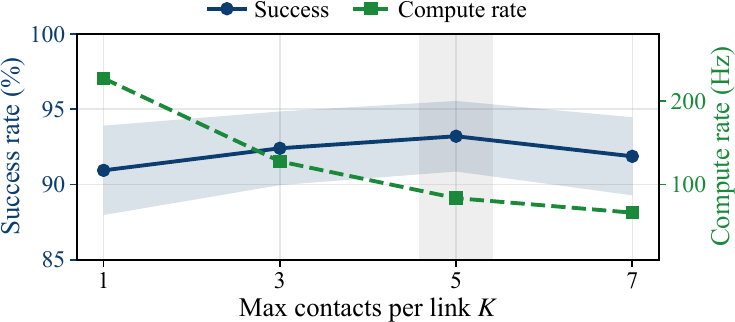
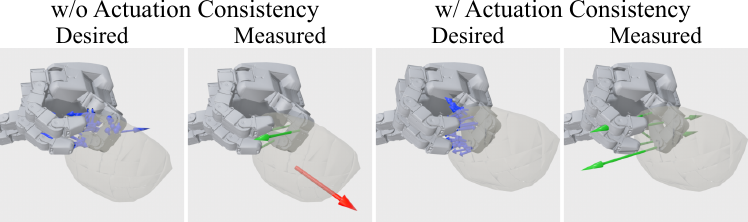
A convex QP allocates contact forces under friction, a minimum squeeze, torque limits and an actuation-consistency constraint. Solved at about 84 Hz.
With reactive reaching in front, a 27-DoF arm-hand system grasps a moving object, holds it through pushes, and regrasps after losing it.
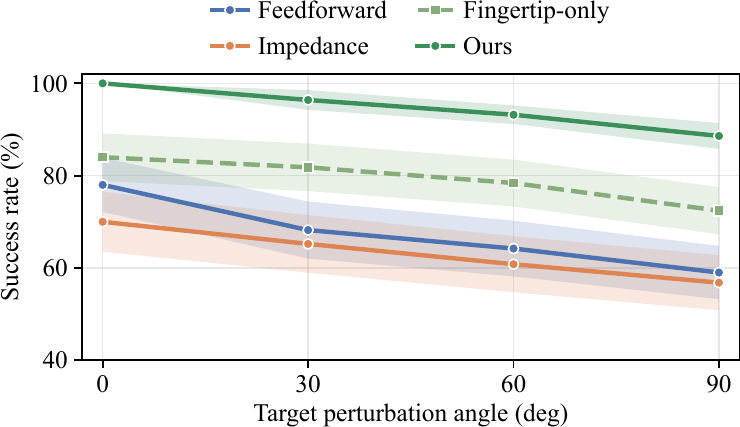
Robust dexterous grasping requires maintaining physical stability despite contacts interactively evolving across the entire hand. A precomputed force distribution can easily fail under object motion, modeling errors, or external disturbances. In this paper, we present a framework for real-time force regulation over dynamically changing whole-hand contacts. Our method geometrically estimates contacts across all hand links using a tracked object model and proprioception, without requiring tactile sensing at those contacts. It repeatedly recomputes the desired contact-force distribution subject to friction constraints, actuator limits, and an actuation-consistency constraint motivated by classical whole-limb force analysis. We integrate this force-regulation controller with reactive reaching, enabling the hand to acquire a grasp, maintain it under disturbances, and regrasp after losing the object. Simulation experiments without gravity demonstrate improved grasp retention over fixed-allocation and fingertip-only execution under controlled perturbations, while real-world experiments on a 27-DoF arm-hand system demonstrate grasp maintenance and recovery under human-applied disturbances as contacts evolve across the whole hand.

Every control cycle: estimate contacts from geometry, re-solve the forces, repeat.
The object mesh comes from CAD or a short RGB-D scan; its SDF is precomputed once. Each cycle, candidate points on every link are placed with the tracked pose and joint angles, and the closest ones per link become contacts. The palm counts too.
A QP minimizes the residual object wrench under friction pyramids, a minimum normal force, joint-torque limits and an actuation-consistency constraint that removes forces the finger joints cannot produce.
Reactive reaching drives the fingertips and palm to a grasp that follows the tracked object. Thumb plus two fingers in contact hands over to force regulation; if the object is lost, control returns to reaching.
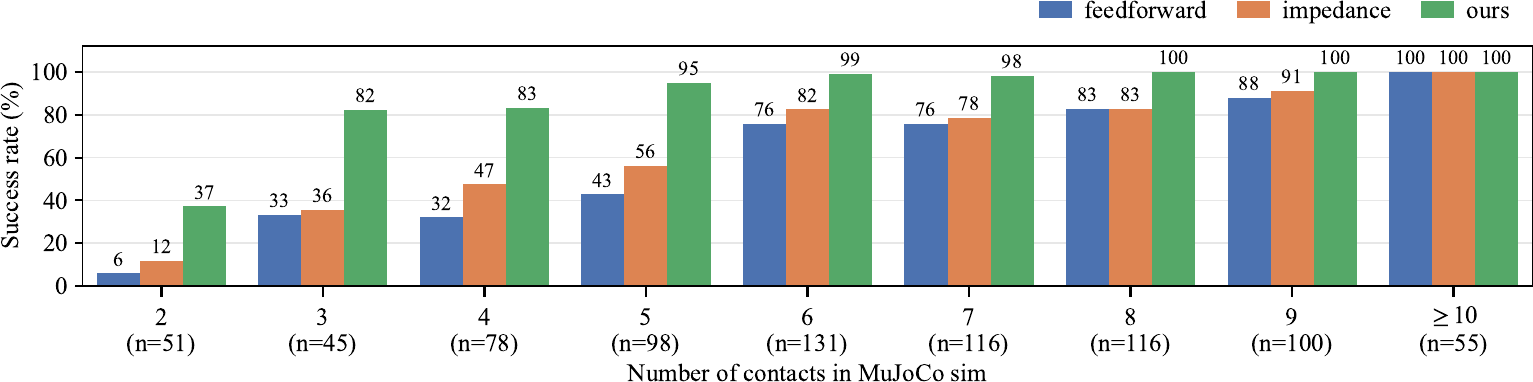
MuJoCo, 79 YCB objects, 10 power grasps each, gravity off. Baselines allocate forces once at initialization and hold them as fixed torques (feedforward) or impedance targets.
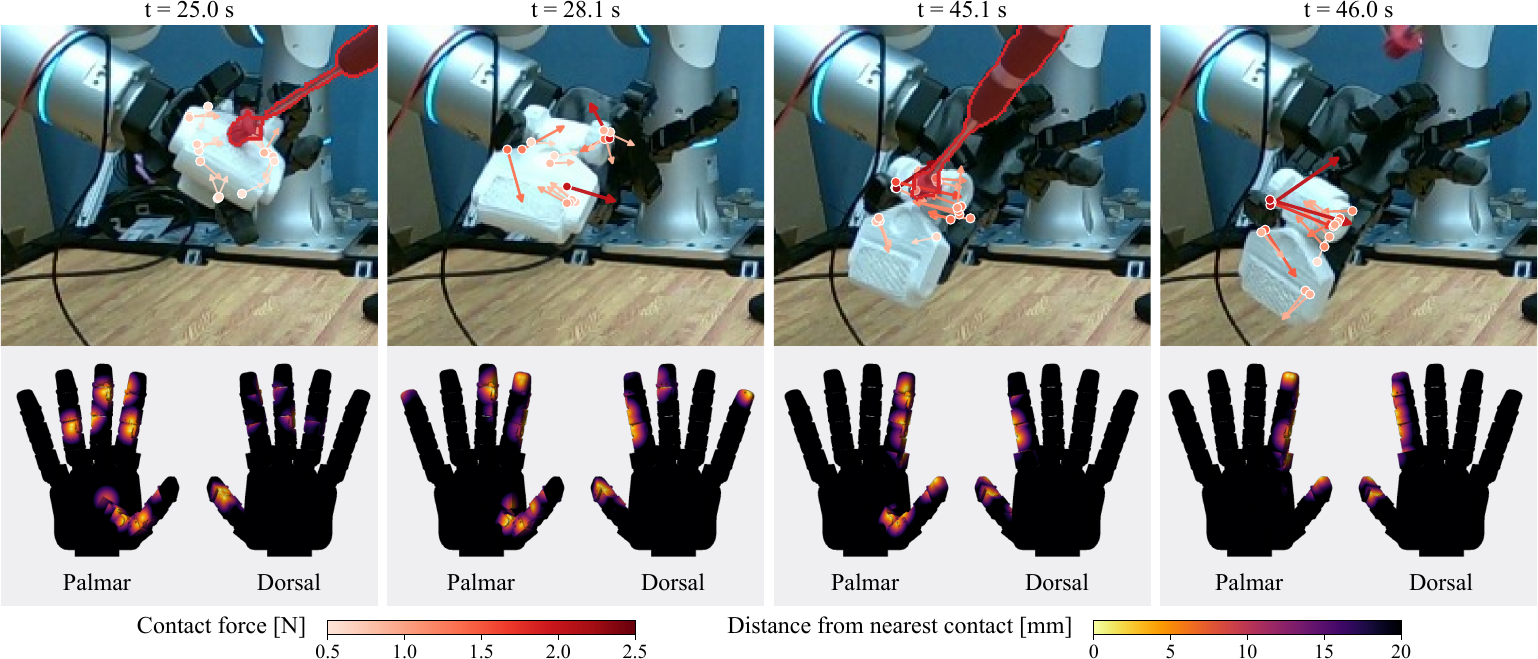
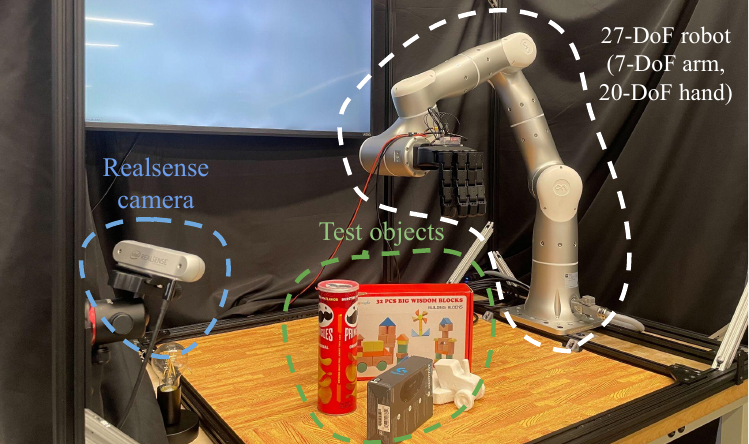
A 7-DoF Flexiv Rizon 4 arm and a 20-DoF Robotis 5F hand with one RealSense D455 and no tactile sensing. Objects are scanned by hand and tracked at 30 Hz. The three runs play, uncut, in the viewer at the top of the page.
| Object | Duration | Perturbations | Losses | Recovered |
|---|---|---|---|---|
| Pringles | 59 s | 16 | 3 | 3 / 3 |
| Small box | 48 s | 31 | 2 | 1 / 2 |
| Large box | 94 s | 31 | 3 | 2 / 3 |
78 perturbations over about 200 s; six of eight losses recovered without intervention.
Tactile skins sense only where they are mounted, and grasp priors place contacts where a taxonomy expects them. Our estimator searches the whole hand surface, so neither assumption is needed: here the fingers alternate in front of and behind the can, and the ones holding it with their dorsal surface are regulated through the same contact Jacobian.
TBA